
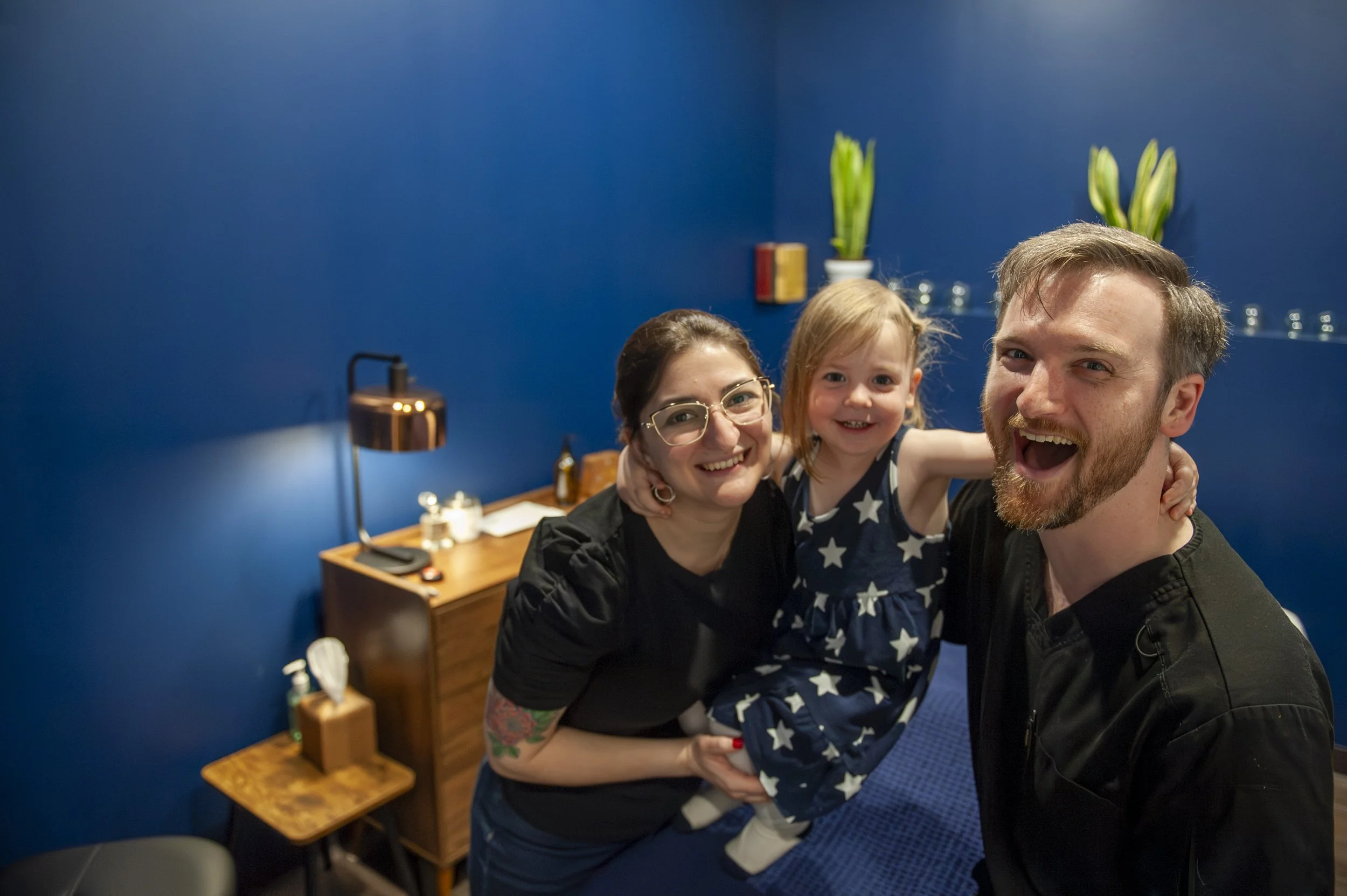
What made you decide to open your own clinic?
I previously had my own practice from 2017 to 2019, but chose to leave that for the opportunity of employment for many reasons. After five years of focusing on my skills as a clinician and working as an employee, I learned a tremendous amount both from my patients, and also from the leaders around me with the courage to pursue their own visions.
I ultimately decided to return to private practice and open my own clinic in pursuit of balance. Understanding that much of life is out of my control, I took the steps necessary to allow me to spend as much time with my wife and young child as possible, while still maintaining a healthy commitment to patients I serve.
What was your path to becoming an acupuncturist?
During my junior year as a material science engineering major at the University of Illinois Urbana-Champaign I took an elective course in Medicinal Plants and Herbology out of sheer curiosity. Learning this material felt like coming home; there was something about learning all the names and classes of the herbs that felt incredibly familiar and rewarding. It was in that class that I had my first exposure to some of the basic theories of Chinese herbal medicine.
This was the spark that ignited my passion for the study of Chinese medicine. I followed that drive first to the Pacific College of Health and Science in Chicago (formerly the Pacific College of Oriental Medicine), where I acquired a foundation in Chinese medicine theory and Asian bodywork therapies. I then transferred to the Seattle Institute of East Asian Medicine (formerly the Seattle Institute of Oriental Medicine) in pursuit of an education more grounded in the classics of Chinese medicine that included regular instruction in qigong for both self-cultivation and patient education, with a clinical experience that involved observation of masters and above-average hours of hands-on experience treating patients.
I ultimately graduated from the Seattle Institute of East Asian Medicine in 2014 and have been a practicing acupuncturist, herbalist, and qigong instructor since.
Why did you decide to study in Asia?
After I graduated from school in Seattle, I began to study Mandarin. We had classes in medical Chinese at the Seattle Institute of East Asian Medicine, but no time to learn to speak and understand the modern language. I wanted to learn the language for a few reasons: I was fascinated by it, a love of the characters, the challenge of learning tones, the way so much could be said with so little; it was the native language in which the medicine I had learned was recorded over thousands of years. I felt that by learning the language, I would gain unique access to aspects of the culture out of which my medicine had grown, and that that would give me a greater understanding of the medicine and ultimately make me into a better practitioner.
I spent 2015 to 2017 living with my wife in Taiwan, learning Mandarin. All this was to prepare for living with a family in Beijing while interning with two Chinese medicine doctors and studying with a taiji and qigong master. Half my time was spent observing these doctors in their clinics, with time for questions and instruction, and half was spent studying qigong and taiji quan at the Earth Temple Park with Master Chen Xiang, a man who instructed two of my qigong and taiji teachers from Seattle.
One of the greatest takeaways from my experiences in the clinics was observing Chinese medicine in a setting where everything felt natural: neither the patients nor the practitioners seemed to be engaged in something foreign or exotic. Having steeped in so many of those moments, I now carry that feeling of natural fluidity in my heart and feel great joy in every new moment when I can share it with someone else.
What other interests do you have?
Besides Chinese medicine and the language, I’ve had many interests and hobbies over the years. At the moment, one of the things I find time for is playing the 古琴 gǔqín, a classical seven-stringed Chinese instrument that I bought from an instrument maker in Taiwan after taking lessons at his shop for six months.
When I have time I enjoy practicing Shorinji Kempo with friends, a martial art whose purpose is to strengthen individual character while spreading world peace and happiness.
I also have a great love of tea. The spirit of tea has carried me to many great gatherings and fostered many great conversations and friendships. I like to appreciate tea in its purest form without any additions, and those that have undergone traditional processes. I enjoy looking for just the right vessel and type of tea for the weather, the time of day, the guest at the door, or the state of my heart; it warms my heart to see the faces of friends and acquaintances as they experience tea in its purest form and have the realization, “oh… this is what tea can be!” I learned an incredible amount about tea in Taiwan, informally in the shops of tea sellers, and formally in Taipei where I learned 功夫茶 gōngfū chá in preparation for volunteering as a tea master at the Dharma Drum Mountain World Center for Buddhist Education during the 2017 lunar new year festival.
I am an adventurer and a seeker of new experiences. I love making new friends and trying new things. The wanderer in me has led me to become who I am today and who I will become in the future. I look forward to meeting and helping whoever walks through my door for whatever reason. I look forward not only to helping you, but to learning from you, my future patients, my greatest teachers.